
The Journey system
Journey is one of the four systems the developer names in the demo announcement. In the character screen it has its own tab, Journey Gallery, alongside Profile — so progress is recorded per character rather than in one global counter.
Journey is the one system in the demo that does not announce itself. There is no tutorial pop-up, no glowing icon, and no meter on the HUD. It lives one layer down, in the character screen, as a tab called Journey Gallery. Understanding what it is doing there is the difference between playing the demo as a short story and playing it as the front end of a much longer one.
What the developer says Journey is
The 20 June 2026 announcement lists four things the demo contains, and the Journey system is second on that list, between optional free-roam sections and detailed character profiles. That placement is informative. Free-roam is about space, profiles are about information, and Journey sits between them — a system that turns the places you go and the people you meet into a record.
The announcement does not describe the mechanics in prose. What it does instead is name the system as a selling point alongside three other things a player can see for themselves, which tells you it is meant to be noticed.
Where it actually lives
Open the character screen and select a character. The dossier opens with Profile, Occupation, Likes, Dislikes, Kinks, Relationship and Memories. At the top right of that screen there is a second tab: Journey Gallery.
That single placement answers the most important question about the system. Journey is not a global progress bar. It is attached to a character. Whatever it records, it records per person, which means the game is tracking more than one journey at a time and expects you to move between them.
| Layer | Where you see it | What it appears to track |
|---|---|---|
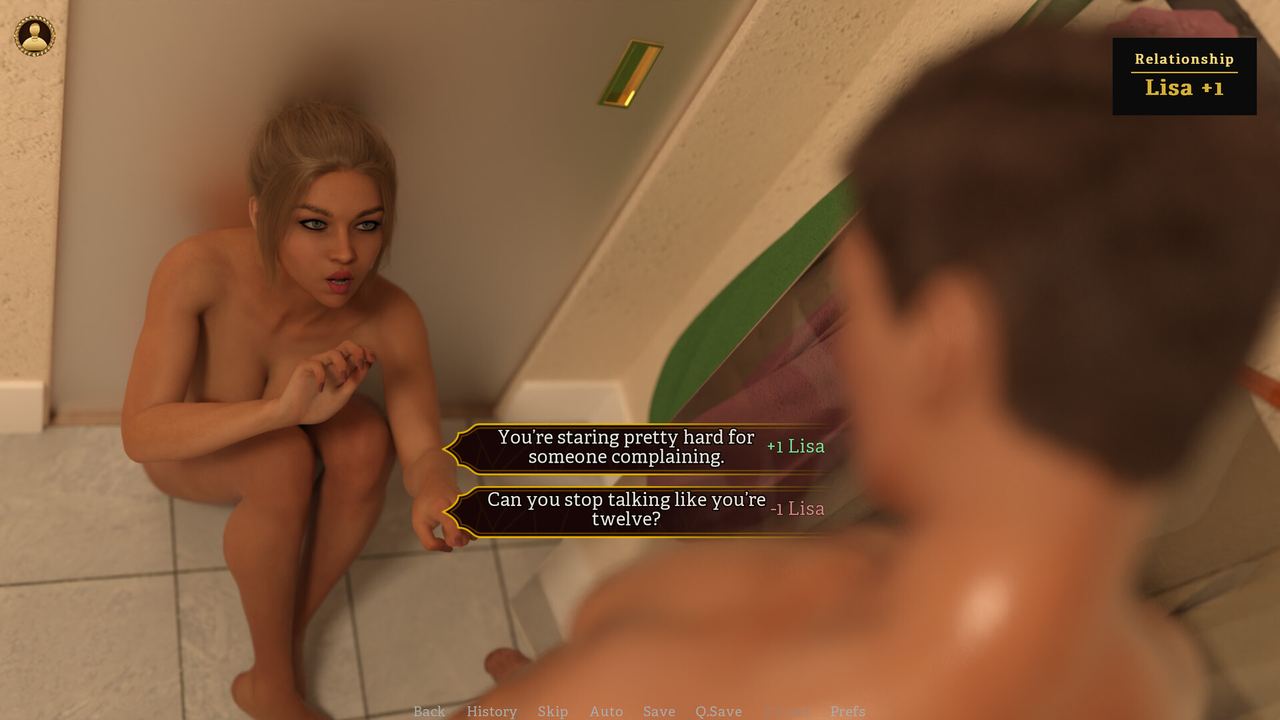
| Relationship | A counter over the dialogue box during play | The immediate effect of a line or choice |
| Journey | The Journey Gallery tab on each dossier | Progress through that character's arc |
| Profile fields | The dossier body | Who the character is: age, job, preferences |
| Memories | A section of the dossier | What the protagonist has learned or lived through |
Why a journey layer makes sense here
A branching visual novel has a structural problem: the player needs to know how far along a route they are without being told what happens next. Relationship counters alone do not solve it, because a counter can go up and down and still leave you unsure whether you are on a route or just being polite.
A per-character progress record solves it. It gives the writer a place to hang milestones, and it gives the player a way to see that a character's story has moved even when the last three conversations were small talk. In a game built around returning to a town and re-meeting people, "how far have I got with this person" is the natural question, and Journey is the answer to it.
It also explains why the tab is called a gallery rather than a log. A gallery implies entries you collect, which suggests the full game will fill it with scenes rather than percentages.
How to read it in the demo
There is no wrong order, but there is a more informative one.
- Play a scene with a character, then open their dossier and look at Journey Gallery. Whatever changed is the system responding to the scene you just played.
- Do the same after a free-roam section. If exploration writes to the gallery, you will see it here.
- Compare two characters after the same scene. If both moved, Journey is scene-driven; if only one did, it is relationship-driven.
- Reload a Q.Save, take the other line, and compare again. The difference is the clearest demonstration of what the system is measuring.
None of that requires a guide, and all of it is more reliable than any second-hand description, including this one.
The demo's version versus the full game's
The demo is the opening arc, which means its Journey entries cover the first few beats of each relationship. The full release is where the gallery becomes a record of a whole story, and where the difference between a character you invested in and one you ignored becomes visible as a set of missing entries.
That is also the strongest argument for the demo existing at all. A player who finishes the demo with two characters at different Journey stages has already seen the shape of the full game's structure without being told a single plot point.
What to watch for after launch
Three things will decide whether Journey earns its name. Whether entries are scenes (which makes the gallery a scrapbook) or states (which makes it a route tracker). Whether the gallery is retroactive, so a player who replays can see what they missed. And whether the system rewards breadth — several characters at a medium stage — or depth, one character at the end of their track.
The demo shows you the interface. The full game on 26 February 2027 is where the answers live.
Read this alongside the demo guide for the other three systems, character profiles for the dossier fields, and relationships and routes for the counter that feeds into it.
All observations here come from the demo's own character screen and the developer's 20 June 2026 announcement, checked on 3 November 2026.